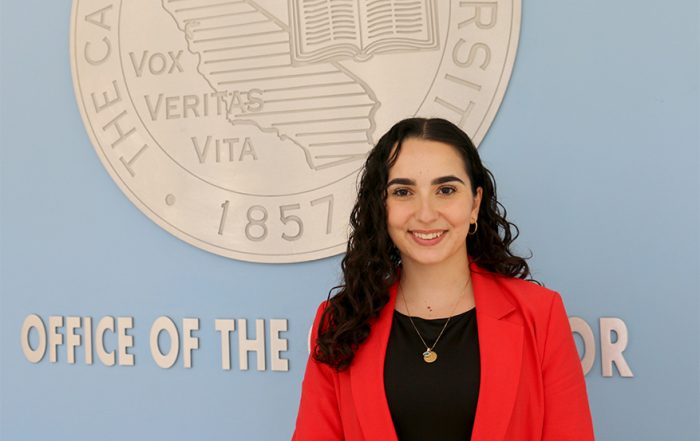
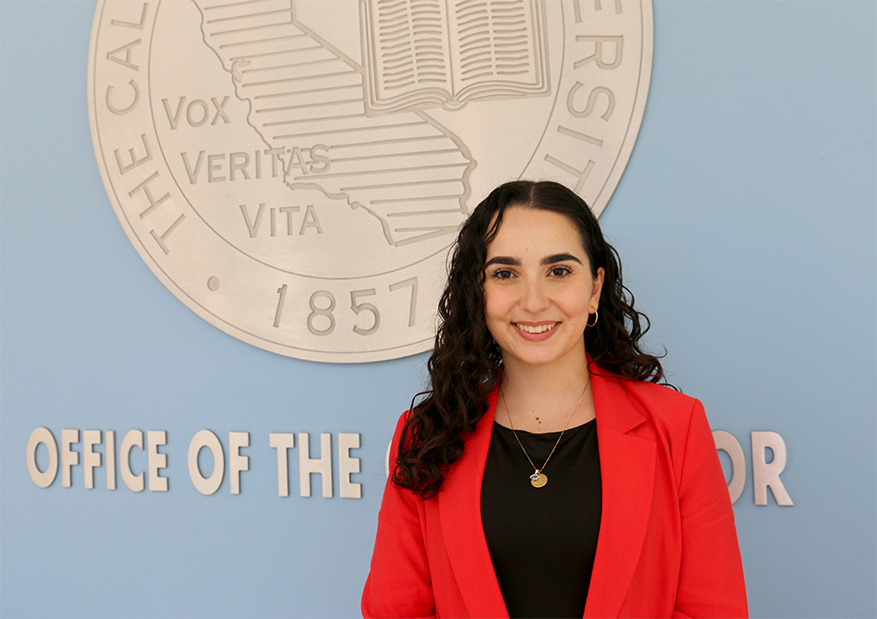
CSSA President Al-Rehani’s report to the CSU Board of Trustees
May 4, 2025
Thank you Chair Clarke, and good morning Trustees, Chancellor García, University Presidents, and everyone else here today. My name is Tara Al-Rehani, and I serve as President of the Cal State Student Association (CSSA), representing nearly half a million CSU students. It is an honor to provide my final report to this body on their behalf today.
Before I discuss CSSA business, I want to commend someone else who will also be concluding their term. Trustee Jazmin Guajardo, your leadership, friendship, support and compassion is so beautiful. You are an amazing leader, you care so deeply about students and we see that in everything you do, big or small. I am honored to have worked alongside you, but also call you a friend!
Since my last report, CSSA has held four board meetings and there is much to cover. On April 26th, CSSA held its executive officer elections for the 26/27 academic year. I’m pleased to announce that Artur Gafurov has been elected to serve as CSSA’s next president! He is currently an undergraduate student from San José State University (SJSU) and has been serving as CSSA’s Vice President of Finance this past year. Artur is a truly dedicated and passionate student leader who will bring a fresh perspective to this role, and I’m excited for the work that he and his team will accomplish! They will be joining you here at the next Board of Trustees meeting in July.
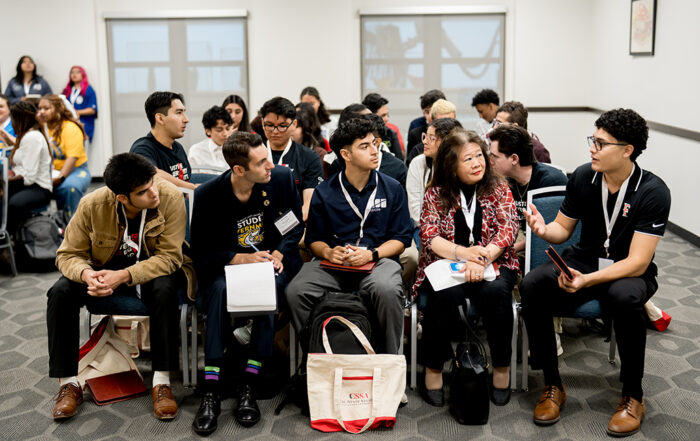
In March, we hosted our 31st Annual CHESS conference, welcoming nearly 220 students from across the CSU for a weekend of education, advocacy, and action. Attendees represented the full breadth of our system, engaging in workshops on CSU challenges, statewide initiatives, CSSA priorities, and advocacy skills. We concluded with a full day of legislative meetings, where students brought their voices directly to policymakers and advocated on behalf of the system.
Central to these conversations were the CSU budget, timely funding, affordability, and protecting institutional capacity and student services. Students emphasized the need for sustained and predictable investment to support the more than 470,000 students we serve, highlighting that funding delays and uncertainty create real instability with students feeling the impact first. Our student leaders continue to urge the Legislature and the Governor to uphold their leadership in supporting the CSU. California’s higher education system works best when students are at the center of every fiscal decision, and sustained investment ensures they can stay enrolled, graduate on time, and access the opportunities higher education provides.
We also hosted a press conference on the Capitol steps focused on CSU funding and CSSA’s legislative priorities. The event elevated the urgency of investing in the CSU and reinforced the student voice. Assemblymember Solache, a CSU alumnus, spoke alongside student leaders, emphasizing both a personal and legislative commitment to protecting CSU funding and the students it serves.
During CSSA’s April Plenary, the board deliberated key legislation from the Systemwide Affairs Committee on student fee alternative consultation reform and opposition to the recently approved executive compensation policy. Our students have expressed frustration in a misalignment of funding priorities and student fee increase methodologies at the university and systemwide level when it comes to these two topics, which led to resolutions passed at our May plenary this past weekend, that call for stronger safeguards on student fees, greater transparency, and a more meaningful role for student voices in systemwide decisions.
These actions reflect a broader commitment to ensuring that financial policies are not made without the direct input of those most impacted and reaffirm that students should not be responsible for offsetting shortfalls in state funding. By strengthening consultation processes around student fee increases and improving accountability measures, we are working to build a more equitable and transparent system for the system’s largest stakeholder group—our students. We continue to highlight the growing affordability crisis students face – rising costs, basic needs insecurity, and barriers to access – and are pushing for policies that prioritize student well-being.
Moving forward, we will keep advocating for meaningful shared governance in financial decision-making at both the university and systemwide levels. This means not only being consulted, but actively shaping outcomes – ensuring student voices are present, heard, and influential every step of the way.
As this work will continue beyond my term, we welcome the continued close partnership and my successor will be happy to help carry this momentum forward!
At the same meeting, we supported several bills centered on student well-being, equity, and accountability. AB 1669 would establish a clear process for medical leaves of absence, allowing students to prioritize their health without risking their academic standing. AB 1831 strengthens accountability in CSU compensation practices, while AB 2374 and SB 1255 create designation frameworks to better support institutions serving historically underserved student populations.
In April, we also supported legislation focused on technology, affordability, and basic needs. AB 2392 promotes responsible use of AI in higher education through training and transparency requirements, AB 2422 protects students from penalties tied to delayed financial aid, and AB 2766 expands housing and enrollment protections for foster and homeless youth. Together, these efforts reflect a continued commitment to equity and student-centered policy solutions.
As this legislative cycle continues, we will monitor how these initiatives can translate into meaningful, tangible improvements for the students we represent.
In April, I had the pleasure of attending CSU Hill Week alongside the Chancellor and her delegation. It was a remarkable experience and yet another example of how action must be driven by stakeholder collaboration. We met with multiple legislators and media representatives to discuss the overwhelming need to acknowledge the diversity and impact of the CSU. As the student representative in these spaces, it was truly a great opportunity to represent the student perspective on issues such as AI Innovation, workforce, accessibility, affordability, and more. A special thank you to the CSU Office of Federal Relations team for all the coordination and preparation they provided for us.
Now, I do want to pause for a moment and share something that our other student representatives have discussed after Hill Week. We all agree that the remarkable students that we serve deserve more, and our system deserves more. The decisions being made at the federal level are disproportionately affecting our universities and are making it increasingly difficult to serve our students in an equitable and socially conscious way. And as the political landscape of our nation continues to shift, it has become critically important to maintain that CSSA continues to support ongoing efforts to push back against unlawful attacks by the federal government.
As our current executive team begins to wrap up the year, we’re also keeping mental health awareness on our radar. I want to make clear that our board of elected student representatives has expressed excitement of the ongoing efforts to enhance after-hours care to our students. Around-the-clock care is a cornerstone of guaranteeing that our students can persist, graduate on time, and transform their own lives. Let there be no confusion around what the officially recognized voice of CSU students believe. We heard it today from our other students, this is not just a higher education issue, this is a human issue. The CO’s support and advocacy on this subject is increasingly important to CSU students and we urge all stakeholders to join us in advocating for increased access so that the reason for this work—students—can succeed.
One year ago, when I was elected to serve in this role, accessibility and equity were my mission. I am the daughter of Iraqi immigrants and the first in my family to navigate a system in a country that was not made to be accessible to students from historically underserved backgrounds. Stepping into this role to represent nearly half a million CSU students at such an impactful level, I was guided by my identity and lived experiences. My goals were to bring the table to our students, uphold a culture of accountability and respect, and enhance shared responsibility with all of our stakeholders, all grounded in a higher commitment to centering students in decision-making.
Through conversations with stakeholders, statements, committee meetings, policy discussions, and legislative advocacy, our work this year has been reflective of what students are experiencing in real time, whether that be preparing for an evolving workforce through AI, navigating barriers to enrollment, or increasing awareness of Title IX services.
At the same time, we did not shy away from moments that required us to be clear and values-driven. Through our statements, we stood in unwavering support of undocumented and mixed-status students during a time of heightened fear and uncertainty, and reaffirmed that access to higher education should never be determined by immigration status. Through our resolutions, we also challenged the system to do better, calling for stronger collaboration and meaningful student voice in decisions that directly impact the cost of attendance and the student experience.
But I am proud of the work we have done. And as this work continues beyond my term, I know the spirit of shared governance and the momentum we built together will not cease. Oftentimes, especially today, some people think that seeing situations differently or disagreeing means you can never work together. To that, I would argue that those people haven’t experienced the leadership at the Chancellor’s Office, led by none other than Chancellor García. In an environment where we frankly agree more than we disagree, but competing priorities can collide, Chancellor García, you have made it a point to always include us, have the hard conversations, and find a solution together.
Throughout this year, I have had the opportunity to participate in meetings with the Chancellor in Sacramento and Washington, D.C., and in many rooms where critical conversations were happening, regarding MSIs, Pell Grant, AI, housing, or the broader future of the CSU. In each of those spaces, I saw a leader who fights relentlessly to ensure the CSU is heard, and heard clearly.
Chancellor García, I want to thank you not only for your advocacy for this system, but for the way you have shown up for me in this role. Your willingness to offer honest feedback, your encouragement to advocate for myself, and your openness in sharing your perspective have shaped my experience in higher education and the kind of leader I am continuing to become.
Thank you for continuing to make space for the student voice in meaningful ways, and for demonstrating that shared governance is not just a principle, but something we must actively practice.
I would be remiss if I didn’t acknowledge clear dedication to these same priorities by all of the people in this room. Over the past year, I have had the opportunity to engage in robust discussions with many of you, and through those moments, I’ve not only learned this system but gained a deeper understanding of how to collaborate, compromise, and accomplish work that positively affects students. I have a deep appreciation for the guidance of thought partners like Dr. Dilcie Perez, Dr. Junius Gonzales, Dr. Nathan Evans, Ray Murrillo, and Jeanne Tran-Martin. It has been a real pleasure to work with you all this year and I must acknowledge the meaningful commitments and work you all have done of centering our shared mission and values every day. I’m deeply grateful for your support and efforts throughout this journey.
I must also recognize my team. Including my chair and vice presidents, Aaron Villarreal, Katie Karroum, Nikki Majidi, Derrick Herrera, and Artur Gafurov, as well as our CSSA staff. Their dedication to uplifting and fighting for students has been the foundation of everything we’ve accomplished.
Before I close my final report to this body, I want to end by highlighting my journey. If you were to tell 17-year-old Tara that she could go from applying to college with a 2.8 GPA to being CSSA President and now graduating Magna Cum Laude, she would have laughed in your face. The last four years of my life at SJSU were made possible by the second chance that I was given because of SJSU’s promise program with my high school district. And along the way, without the support of my mentors, friends, colleagues, and family, I would not be standing here today. It’s leaders like my campus President Cynthia Teniente-Matson who continue to work tirelessly and enhance programs like these that allow students an opportunity to succeed. Thank you!
So, although I will be graduating and moving on, I can do so while being confident that this system will continue to push itself to improve and grow with our students. I know that everyone in this room wants to do more for us and if I had even the smallest impact on that, I will leave happy. I know other students with stories similar to mine and different than mine, will be able to find agency in the CSU and will be able to transform their lives.
Thank you all for your work, your kindness, and support this year!
Chair Clarke, this concludes my final report.